Ayr: Your Complete Waterloo Region Community Guide


There are swans on Watson Pond. They've been there for as long as anyone can remember — gliding across the water in the centre of town, framed by heritage buildings and mature trees, looking like they belong in a storybook rather than a village in the Waterloo Region.
That's Ayr in a single image. A community that looks and feels like it shouldn't exist this close to a mid-sized city — but does. The Nith River winds through. The heritage downtown is lined with stone and brick buildings dating to the 1800s. The streets are quiet enough that the loudest sound on a Tuesday afternoon might be the curling club or the Centennials practising at the arena. And on Saturday mornings, the farmers' market fills the air with the smell of fresh baking while neighbours catch up over coffee.
Ayr is the largest community in the Township of North Dumfries, the southernmost municipality in the Waterloo Region. It's a genuine small town — population roughly 5,400 — with its own schools, its own hockey team, its own heritage, and its own identity. It is emphatically not a subdivision at the edge of a city. And for a growing number of families, that's precisely the appeal.
Location and Geography

Ayr sits south of Kitchener and west of Cambridge, centred on the Nith River in the rolling countryside of North Dumfries Township.
Highway 24 runs through the area, connecting south to Brantford and north toward Cambridge and the 401 corridor. Highway 401 itself is roughly 15 minutes via Highway 24 — making Ayr practical for commuters who work in Cambridge, Kitchener-Waterloo, Guelph, or further along the highway. Highway 8 is accessible to the north.
Cambridge is the nearest city — about 15 minutes by car. Kitchener is roughly 20 minutes. Paris — another charming small town on the Grand River — is a similar distance to the south.
Daily shopping can be handled locally. Ayr has a grocery store, everyday services, and the independent shops and restaurants along the heritage downtown. For larger retail needs, Cambridge's commercial corridors are a short drive.
There is no public transit in Ayr. This is a car-dependent community without exception. If you live here, you drive — and everyone who chooses Ayr has already made peace with that trade-off.
From Mudge's Mills to Ayr: A Scottish Settlement Story
Ayr's history runs deep — and its Scottish roots are written into the landscape.
The area was originally part of a massive land purchase from the Six Nations by Philip Stedman in 1798. Ownership passed through Thomas Clarke and ultimately to William Dickson, a wealthy immigrant from Dumfries, Scotland, who in 1816 recognised the potential of the Nith River and the surrounding fertile land. Dickson encouraged Scottish settlers to buy land, and between 1825 and 1832, every plot was claimed.
The village that would become Ayr was originally three small settlements. Abel Mudge arrived in 1822 and built a dam, a sawmill, and a grist mill at the junction of Smith and Cedar Creeks. The settlement around his mills was called Mudge's Mills. To the east was Jedburgh. To the west, Nithvale. As the three expanded and merged, the combined community took the name Ayr — after Ayr, Scotland — when the post office opened in 1840.
By the mid-1800s, Ayr was a thriving community with churches, schools, and businesses. The railway arrived in the late 1800s, connecting the village to broader markets and accelerating growth. Heritage buildings from this era — stone, brick, and frame construction reflecting the craftsmanship of the period — still line the downtown streets today.
In 1973, Ayr was amalgamated into the Township of North Dumfries as part of the Regional Municipality of Waterloo. But like Hespeler, Galt, and Preston in Cambridge, Ayr's identity survived amalgamation. Ask someone from Ayr where they live and they'll say "Ayr" — not "North Dumfries."
Housing: What to Expect

Ayr's housing stock spans the full history of the community — and the contrast between the heritage core and the newer development is part of what gives the village its character.
Heritage properties along and near the downtown core include some of the most characterful homes in the Waterloo Region. Century homes with original stonework, covered porches, high ceilings, and mature lots sit on quiet streets within walking distance of Watson Pond and the Nith River. These properties attract buyers who value architectural heritage and the experience of living in a home with genuine history.
Established mid-century homes on the village's residential streets offer bungalows, sidesplits, and two-storey family properties on lots that are generous even by small-town standards. Many have been updated by their owners over the decades while retaining the comfortable, unpretentious character of a village that grew gradually.
Newer development on Ayr's southeast side has expanded the village significantly over the past decade. Contemporary two-storey family homes and townhouses with current building standards and modern layouts have brought new families into the community. This growth has been substantial — Ayr has evolved from a quiet heritage village into a community with genuine residential momentum.
Pricing in Ayr reflects the small-town premium — the combination of heritage character, natural setting, and community identity that buyers are willing to pay for. The range spans from accessible townhouse entry points to premium heritage properties and larger acreage lots on the village's edges.
Watson Pond and the Nith River
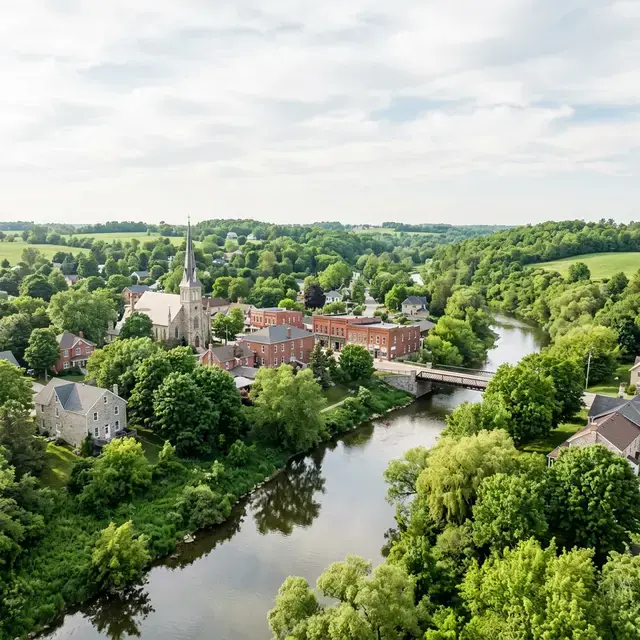
Watson Pond is Ayr's most iconic feature — a picturesque body of water in the heart of the village, home to the swans that have become the community's unofficial symbol.
A scenic walking trail loops around the pond, connecting to the heritage downtown and providing the kind of daily waterside walk that most urban neighbourhoods can only envy. In every season, Watson Pond provides a focal point — spring reflections, summer greenery, autumn colour, and the quiet beauty of ice and snow in winter.
The Nith River flows through the village, adding a second waterway to Ayr's natural landscape. The river and its banks provide walking opportunities and contribute to the rural character that distinguishes Ayr from suburban development.
The Campbell Trail offers a scenic walking route along the river, connecting residential areas to the broader countryside. The trail systems in North Dumfries — including the Dryden Tract, Sudden Tract, and Bond Tract — provide additional hiking through the rolling farmland and wooded areas that surround the village.
Orr's Lake offers another picturesque walking path on a scenic water feature.
The natural landscape around Ayr is genuinely beautiful — rolling hills, river valleys, and agricultural land that has been farmed for two centuries. For residents, this countryside isn't something you drive to on weekends. It's the view from your kitchen window.
Community Life
Ayr punches well above its weight in community infrastructure and identity.
The North Dumfries Community Complex is the village's recreation hub — an indoor ice arena with a walking track, a spray pad and playground, soccer fields, a skatepark, beach volleyball courts, a community garden, an off-leash dog park, and an outdoor walking trail. A second arena operates at the Ayr Community Centre. For a community of 5,400, this level of recreation infrastructure is exceptional.
The Ayr Centennials — a junior hockey team in the Greater Ontario Junior Hockey League — provide the kind of hometown hockey experience that larger communities lost decades ago. Game nights at the arena are genuine community events.
The Ayr Curling Club adds another layer of small-town sporting life. Curling is woven into the social fabric here in a way that urban communities rarely experience.
The Ayr Farmers' Market runs Saturday mornings from May through October — local produce, baking, and the community connections that happen when neighbours meet at market every week.
The Ayr Public Library, housed in a Carnegie library building, serves as a community gathering space beyond its book-lending function.
Murdoch Mysteries — one of Canada's longest-running television series — has filmed extensively in Ayr, drawn by the authentic period streetscape of the heritage downtown. The production activity reflects what residents already know: Ayr's built heritage is genuine and well-preserved.
Schools

Ayr's schools serve the community well.
Ayr Public School has been serving the village since 1890 — one of the area's oldest educational institutions, offering JK through Grade 6. Cedar Creek Public School handles Grades 7 and 8.
St. Brigid Catholic School serves JK through Grade 8 for Catholic school families.
For high school, students travel to Cambridge — attending Galt Collegiate Institute or Jacob Hespeler Secondary School depending on programme and catchment.
The elementary schools are within the village and walkable for most Ayr families. The high school commute to Cambridge is a daily reality — roughly 15 minutes by car or school bus.
Who Thrives in Ayr
Families who want genuine small-town life. Ayr offers something that suburban developments labelled "villages" can't replicate — an actual village with its own identity, its own heritage, its own hockey team, its own downtown, and the kind of community where people know each other by name. If that's what you're looking for, no amount of marketing can substitute for the real thing.
Heritage home enthusiasts. The century homes along Ayr's heritage streets offer architectural character, mature lots, and the craftsmanship of an era when homes were built individually. For buyers who've been searching for heritage properties in the tri-cities, Ayr's heritage stock is worth discovering.
Commuters who want the drive to be worth it. The 15-minute commute to Cambridge or 20 minutes to Kitchener is the price of admission. What you get in return is a genuine small-town life — Watson Pond, the Nith River, the community complex, the farmers' market, the quiet streets, and the countryside at your doorstep. For many families, that trade-off is an easy one.
Buyers seeking newer construction with community character. The southeast development has brought contemporary homes to Ayr without diluting the village's identity. New families are joining a community with established schools, recreation, and social infrastructure — not building one from scratch.
Outdoor enthusiasts. The Nith River, Watson Pond, the Campbell Trail, the township trail systems, and the surrounding countryside provide daily outdoor access in a setting that's genuinely rural rather than suburban-green-space-adjacent.
Honest Considerations
Car-dependent without exception. No transit. Every trip — to work, to school (for high schoolers), to larger shopping — requires a vehicle. If you're considering Ayr, vehicle access is non-negotiable.
The high school commute. Elementary school is local, but high school students travel to Cambridge. This is a daily reality for families with teenagers — roughly 15 minutes each way.
Limited commercial amenities. Ayr's downtown has character and independent businesses, but it's a village — not a city. Larger retail, entertainment, and specialty services require driving to Cambridge or Kitchener. If you need daily access to urban-scale commercial amenities, the commute will add up.
Growth is changing the village. The newer development has brought families and energy, but it has also changed the scale and feel of the community. Long-time residents and newcomers are still finding the balance between growth and preservation. Buyers should visit the heritage core and the newer sections to understand both sides of Ayr's current character.
Rural services apply. North Dumfries Township provides services differently from the cities of Kitchener, Waterloo, and Cambridge. Municipal tax rates, water and wastewater services, road maintenance, and bylaw enforcement may differ from what you're accustomed to in an urban setting.
How Team Pinto Can Help

Ayr is a different kind of market from the tri-cities — smaller inventory, a mix of heritage and contemporary housing, township rather than city jurisdiction, and the specific considerations that come with small-town property.
At Team Pinto, we serve buyers and sellers across the full Waterloo Region, including the townships. We can help you evaluate whether Ayr's combination of heritage character, natural setting, and small-town community aligns with your priorities, navigate the differences between village and city real estate, and identify opportunities in a community where the right property may not come up often.

Ready to explore what Ayr has to offer? Contact Team Pinto at 519-818-5445 or visit teampinto.com. Whether Ayr is the right fit or another community in the Waterloo Region better matches your goals, we'll help you find where you belong.
Team Pinto serves buyers and sellers across Kitchener, Waterloo, Cambridge, and the surrounding communities of the Waterloo Region. Whether you're purchasing your first home or your fifth, we bring local expertise and a commitment to helping you make smart real estate decisions.


