Preston: Your Complete Waterloo Region Neighbourhood Guide


Cambridge has three historic hearts, and Preston is the one that sits right where the rivers meet.
The Speed River and the Grand River converge here — two of Waterloo Region's most significant waterways joining together within the community's boundaries — and that confluence has shaped everything about Preston for more than two centuries. John Erb built a grist mill on the Speed River in 1807, making the site what's now recognised as the oldest continuously operating industrial location in the region.
A town grew around those mills. Hotels followed, built to serve visitors who came for Preston's sulphur mineral springs, believed to have curative powers. Factories came next — furniture, stoves, textiles, flour — and by the early 1900s Preston was a thriving industrial town connected by electric railway to Galt, Hespeler, Kitchener, and beyond.
That history still lives in the community today. You can see it in the heritage streetscape along King Street, in the flour mill that's been operating on the same site for more than two centuries, in the 102-hectare Riverside Park that stretches along the river, and in the fierce local pride that keeps Preston residents identifying as "from Preston" rather than "from Cambridge" — more than fifty years after amalgamation. But what makes Preston compelling for buyers right now isn't just the heritage. It's the combination of that character with genuine affordability, strong recreation infrastructure, improving transit prospects, and a central Cambridge location that connects easily to everywhere else.
Location and Geography
Preston occupies the western section of Cambridge, centred along King Street — its historic commercial spine — with the Speed River running through the community's core and the Grand River forming its western and southern edges.
The location is more connected than many people realise. Highway 401 is close to the south, accessible via Highway 24 and Fountain Street, making Preston practical for commuters heading east toward Toronto or west toward London. Highway 24 itself runs through the area, connecting south to Brantford and north toward Guelph. Hespeler Road, the major commercial arterial, provides a direct route north to Kitchener-Waterloo.
Cambridge Centre Mall and the surrounding commercial corridor along Hespeler Road are a short drive from most of Preston, handling the big-box shopping and services that serve daily life. Within Preston itself, King Street and the surrounding blocks provide local commercial activity — restaurants, services, and the kind of independent businesses that give a community its day-to-day character.
Grand River Transit bus routes serve Preston and connect to the broader Cambridge and Kitchener-Waterloo transit networks. Significantly, Preston is part of the planned Stage 2 ION rapid transit extension to Cambridge — a future LRT connection that, when built, would fundamentally change the neighbourhood's transit accessibility and likely its real estate dynamics. While the timeline for this extension remains under regional discussion, the planned route through Preston is a factor that forward-thinking buyers should have on their radar.
From Mineral Springs to Mill Town: Preston's History

Preston's founding story begins with water — both the rivers that powered its mills and the sulphur springs that made it famous.
John Erb, a Mennonite settler from Pennsylvania, arrived at the confluence of the Speed and Grand Rivers in 1805 and built a sawmill in 1806 followed by a grist mill in 1807. That grist mill — operating on the same Speed River site for more than two centuries — became the foundation of what would eventually become Dover Flour Mills, a business that still produces flour today. The site is recognised as the oldest continuously operating industrial location in Waterloo Region, a distinction that connects Preston's present directly to its earliest days.
The mineral springs were discovered accidentally in 1837 when a member of the Erb family drilled for salt and found sulphur water instead. What seemed worthless at first quickly became valuable — the high-sulphur water was promoted as treatment for arthritis, rheumatism, and other ailments. Three major hotels rose to serve the visitors: the North American (later the Kress Hotel, opened 1840), the Del Monte (later the Preston Springs Hotel, operating before 1888), and the Sulphur Springs Hotel (mid-1890s). Preston became a destination for health seekers from across North America, giving the community a cosmopolitan character unusual for a small Ontario town.
The Preston Springs Hotel — a grand landmark visible from across the community — stood as a reminder of that era until its demolition in 2020 for safety reasons. Its loss was felt deeply by residents, a reflection of how much the community's built heritage means to the people who live here.
Meanwhile, industry flourished. The Preston post office opened in 1837, and by 1879 the community supported a foundry, carriage manufacturers, potteries, furniture companies, and the Cherry Flour Mills. The electric railway arrived in 1894, initially connecting Preston to Galt and eventually extending to Hespeler, Kitchener, Waterloo, and Brantford. By 1899, Preston was incorporated as a town.
In 1973, Preston was amalgamated with Galt, Hespeler, and Blair to form Cambridge. Like its Cambridge neighbours, Preston maintains a strong independent identity — residents still say they're "from Preston" first and Cambridge second, and the Preston Towne Centre BIA works actively to maintain the community's distinct character.
Housing: What to Expect

Preston's housing stock is genuinely diverse, spanning more than a century of construction across several distinct areas, and offering some of the most accessible price points in the Waterloo Region market.
The historic core along and near King Street features the oldest homes — Victorian and Edwardian properties, workers' cottages, and solid brick homes dating from the late 1800s through the early 1900s. These character properties offer the architectural detail, mature lots, and walkability to the village centre that heritage home buyers look for. Century homes along streets like Queenston Road include some beautiful Queen Anne-style properties that reflect Preston's prosperous industrial past.
Established residential streets in north and south Preston offer mid-century homes — bungalows, backsplits, and sidesplits from the 1950s through 1970s — on mature, tree-lined streets with generous lot sizes. These are the kind of solid, well-proportioned homes that families find appealing: basements with development potential, attached or detached garages, and the kind of settled streetscapes that come from decades of owner investment.

Preston Heights, closer to Highway 401, features newer construction — homes built within the last 20 to 30 years alongside ongoing development. This area appeals to commuters who want highway proximity and more contemporary housing stock. The mix includes detached homes, townhouses, and newer condo development.
Townhouses and condos are well represented across Preston, providing entry points for first-time buyers, downsizers, and investors. Newer condo development along the King Street corridor is adding contemporary housing options within the village core.
Pricing in Preston is one of its most compelling features. Across property types, Preston offers genuine value relative to both the broader Cambridge market and especially compared to Kitchener-Waterloo pricing. For buyers who've been searching in KW and finding themselves priced out of the neighbourhoods they want, Preston delivers community character, river access, and heritage housing at price points that often come as a pleasant surprise.
Understanding the differences between Preston's various pockets is where your buyer's agent earns their value. The quiet heritage streets near Riverside Park, the busier sections along King Street, the newer developments in Preston Heights, and the established mid-century residential areas each serve different buyers at different price points. At Team Pinto, helping buyers navigate these distinctions is part of how we ensure you find the right home — not just any home in the right postal code.
Riverside Park and Green Space

Riverside Park is Preston's crown jewel — and by any measure, it's one of the most significant community parks in Waterloo Region.
At 102 hectares, Riverside Park stretches along the Speed River through the heart of Preston. The park was established in the early twentieth century, and its heritage entrance gates — constructed in 1921-22 to commemorate Preston soldiers who served in World War I — are designated under the Ontario Heritage Act.
Inside, the scale is impressive. Walking and cycling trails wind through the park's length. Sports fields serve baseball, soccer, and other organised sports. A splash pad, two playgrounds, tennis courts, a skateboard park, and extensive picnic areas — some bookable for events — make this a park that serves families across all ages. Canada Day celebrations are a Riverside Park tradition, with events, performances, and fireworks drawing the community together annually.
The Mill Run Trail extends 7.5 kilometres northeast from Riverside Park along the banks of the Speed River, connecting all the way to Hespeler. This trail passes through naturalized areas and the former Chilligo Conservation Area, providing a genuine long-distance walking and cycling route that links two of Cambridge's three historic communities along the river that shaped them both.
Central Park, located in the heart of the Preston Towne Centre business area on King Street, serves a different function — it's the community's gathering place. Officially opened as part of Preston's incorporation day on September 30, 1899, Central Park features a bandshell that hosts summer concerts, a spray pad, a winter ice rink, seasonal light festivals, and a farmers' market. It's the kind of small, well-loved urban park that gives a village centre its social energy.
Linear Park adds additional trail connectivity, with paths for walking, running, and cycling that extend the green space network through the community.
The confluence of the Speed and Grand Rivers gives Preston a waterfront character that's rare in Waterloo Region's inland communities. The rivers aren't just scenic backdrops — they're functional amenities that shape trail routes, park experiences, and the daily rhythm of life for residents who live near them.
Community Infrastructure

Preston Towne Centre BIA supports the King Street commercial core, organising events, marketing local businesses, and working to maintain the heritage character that distinguishes Preston's village centre. The BIA's active presence reflects genuine community investment in keeping Preston's identity alive.
Cambridge Centre Mall and the Hespeler Road commercial corridor are nearby, providing the larger retail, grocery, and service options that serve daily needs. Within Preston itself, King Street offers local restaurants, professional services, and independent businesses.
The Preston Memorial Auditorium serves as a community recreation facility, and the broader Cambridge recreation network provides additional programming and facilities accessible to Preston residents.
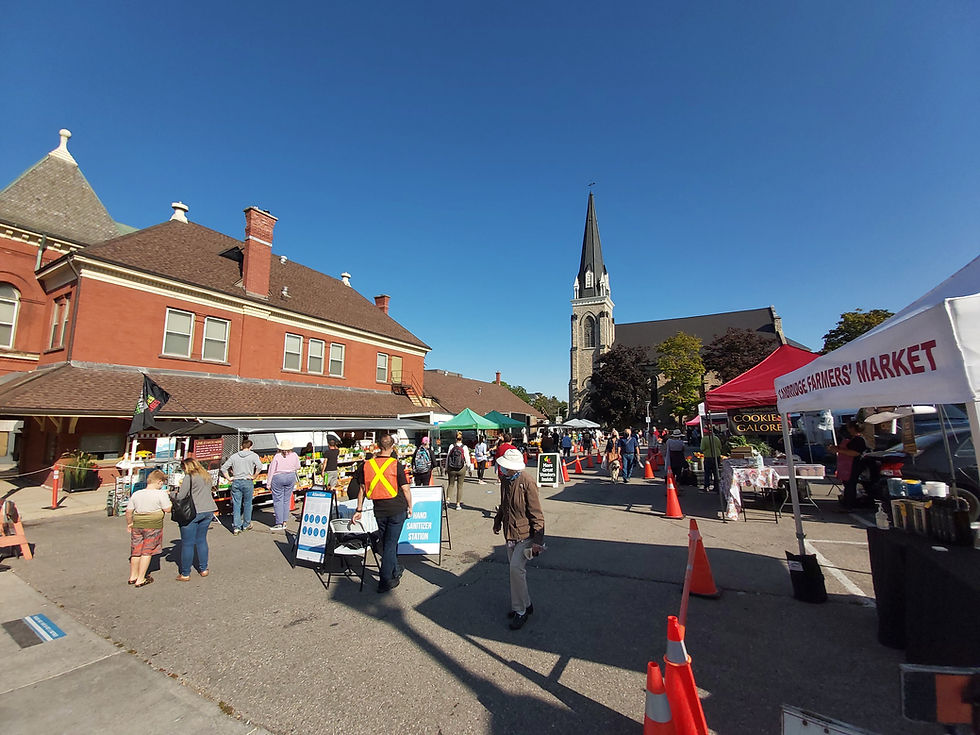
The Cambridge Farmers' Market at Central Park brings local produce, baked goods, and artisan goods to the neighbourhood seasonally — the kind of recurring community event that builds connection between residents and reinforces the village-centre character.
Schools
Preston is well served by schools at multiple levels.
For public school students, Preston Public School, Coronation Public School, Grandview Public School, Parkway Public School, and Blue Heron Public School serve elementary grades depending on location. William G. Davis Senior Public School handles intermediate grades. Preston High School is the secondary school — a community institution with deep roots in the neighbourhood.
Catholic school families are served by St. Michael's Catholic Elementary School and St. Joseph's Catholic Elementary School, with Monsignor Doyle Catholic Secondary School for high school.
As with all Waterloo Region neighbourhoods, school assignments depend on your specific address, and catchment boundaries can vary in ways that aren't always intuitive. Your buyer's agent should be confirming the exact school assignments for any property you're considering — at Team Pinto, this is standard practice.
Who Thrives in Preston
Value-seeking buyers who want community character. Preston delivers something increasingly rare in Waterloo Region — genuine heritage character, river access, established parks, and a walkable village core at price points that are significantly more accessible than comparable qualities in Kitchener-Waterloo. If character and value are both on your list, Preston belongs on your shortlist.
Families appreciate the combination of Riverside Park (one of the largest and best-equipped community parks in the region), established schools, safe residential streets, and the trail connectivity that keeps children active and outdoors. The scale of Riverside Park alone — 102 hectares of sports fields, playgrounds, trails, and river access — is a family amenity that most communities simply can't match.
Heritage home enthusiasts find character properties in the village core with the kind of architectural detail and craftsmanship that reflects Preston's prosperous industrial past. Victorian and Queen Anne-style homes on established streets offer the period features — original woodwork, high ceilings, covered porches, decorative brickwork — that heritage buyers seek.
Commuters benefit from Preston's Highway 401 access and the broader highway connectivity through Highways 24 and 8. The commute to Kitchener-Waterloo is straightforward, and the future ION LRT extension — when it arrives — would add rapid transit connectivity that could significantly enhance Preston's appeal and accessibility.
Forward-thinking buyers and investors. The planned ION extension through Preston, combined with ongoing investment in the King Street corridor and the community's heritage character, creates a trajectory that attentive buyers are watching closely. Preston's combination of current affordability and future transit potential is a compelling long-term value proposition.
Honest Considerations
Preston is still finding its next chapter. The King Street corridor has genuine heritage character and is seeing investment, but it's not yet a fully realised village high street. Some storefronts are vacant, and the retail and dining density is still developing. Buyers who see the trajectory and are comfortable with a community that's building momentum will find opportunity here. Those who want everything polished and complete today should calibrate expectations.
Heritage homes require realistic assessment. Century-old homes in Preston — as anywhere — come with the realities of aging construction. Foundation conditions, electrical and plumbing systems, insulation levels, and structural integrity all need thorough inspection. Budget for updates and work with an inspector experienced in older homes. Your agent should be helping you understand what's cosmetic versus what's structural.
The ION extension timeline is uncertain. While the Stage 2 LRT through Preston is part of the regional plan, the construction timeline has not been finalised. Buying in Preston on the assumption that LRT will arrive on a specific schedule would be speculative. Buy because the community works for you today, and treat the future transit connection as a bonus.
Proximity to Highway 401 and commercial corridors. Properties in Preston Heights near the highway will experience road noise. Properties along or near King Street's commercial sections will have more traffic and activity than the quieter residential streets deeper into the neighbourhood. Listen during your visit and assess what trade-offs work for you.
Flood considerations near the rivers. Properties near the Speed and Grand Rivers should be evaluated for flood plain status. The Grand River Conservation Authority manages flood plain mapping, and your buyer's agent should be verifying this for any property near the water. The 1974 Grand River flood, which caused significant damage in parts of Cambridge, is a historical reminder of why this due diligence matters.
How Team Pinto Can Help

Preston rewards buyers who take the time to understand its different areas — the heritage village core, the established mid-century residential streets, the newer Preston Heights development, and the emerging opportunities along the revitalising King Street corridor. These areas serve different buyers at different price points, and navigating the nuances requires local knowledge.
At Team Pinto, we serve buyers and sellers across the full Waterloo Region, including all three of Cambridge's historic communities. We can help you evaluate whether Preston's combination of character, value, and future potential aligns with your priorities, guide you through the specific considerations of heritage housing stock and riverside properties, and identify opportunities in a community where informed buyers are finding genuine value.

Ready to explore what Preston has to offer? Contact Team Pinto at 519-818-5445 or visit teampinto.com. Whether Preston is the right fit or another Waterloo Region neighbourhood better matches your goals, we'll help you find where you belong.
Team Pinto serves buyers and sellers across Kitchener, Waterloo, Cambridge, and the surrounding communities of Waterloo Region. Whether you're purchasing your first home or your fifth, we bring local expertise and a commitment to helping you make smart real estate decisions.


