The Problem-Solving Garden: Landscaping That Fixes What's Wrong With Your Yard

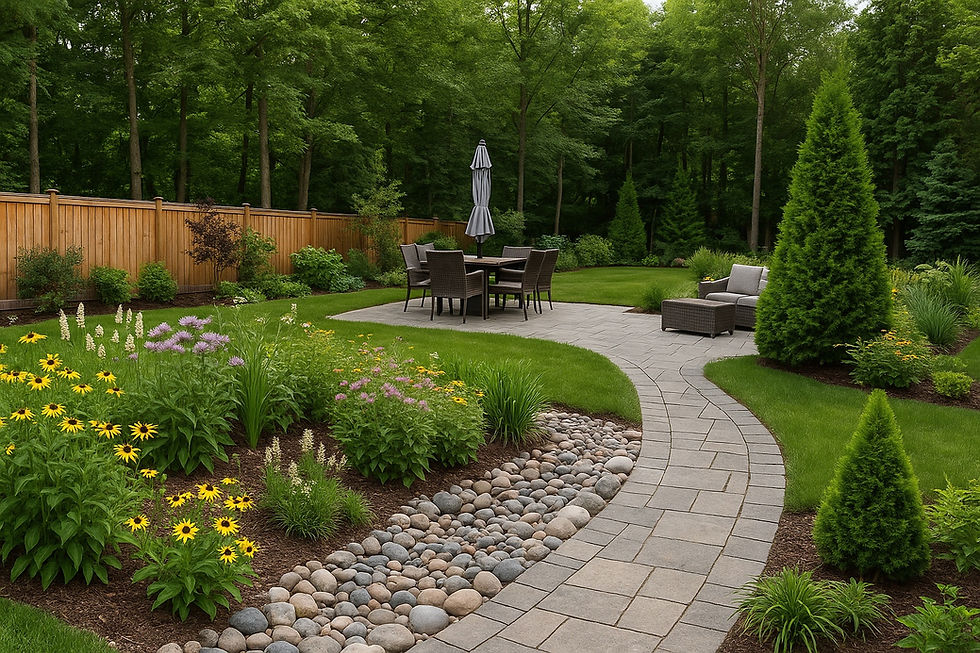
Your property's landscape does more than look good from the street — it's a working system that affects your home's comfort, energy costs, maintenance demands, and market value. And when that system isn't working, you feel it.
The wind that rips through every winter and drives your heating bills up. The corner that's permanently soggy after rain because the grading isn't doing its job. The highway noise that makes your patio unusable. The slope that's slowly losing soil toward the foundation. The south-facing deck that turns into a furnace by 2 p.m. in July. These aren't just aesthetic issues — they're functional problems that affect how you experience your home and how buyers will evaluate it.
The right plants, placed strategically, solve them. And the best part? Plants that solve problems also happen to increase your property value, improve curb appeal, and require less maintenance than fighting the same issues year after year with temporary fixes.
Here are the most common yard problems in Waterloo Region — and the plants that fix them.
The Problem: Wind Exposure

The Waterloo Region gets serious wind, particularly from the north and west in winter. If your property sits on an exposed lot — common in newer subdivisions where the trees haven't grown in yet — you feel it every time you step outside from November through March. Wind-chill makes your outdoor space unusable. Snow drifts pile up in the wrong places. Your heating costs climb as cold air hammers the north and west sides of your home.
The fix: a windbreak.
A well-placed row of evergreen trees on the windward side of your property can reduce wind speed by up to 50 per cent for a distance of 10 to 15 times the height of the trees. That's not a small effect — it changes how your entire yard feels in winter, and it can meaningfully reduce your heating bills.
What to plant in Zone 5b:
White spruce is one of the most reliable windbreak trees for our climate. Fast-growing, dense, pest-resistant, and fully hardy. It forms a thick barrier that blocks wind year-round and requires almost no maintenance once established.
Norway spruce is another strong choice — it grows quickly, reaches impressive height, and its dense branches provide excellent wind protection. It's one of the most commonly used windbreak trees in Ontario for good reason.
Eastern white cedar (arborvitae) works well for smaller properties where a full-sized spruce row isn't practical. Cedars can be planted as a dense hedge that provides effective wind reduction at a more manageable scale.
Placement matters. Plant your windbreak perpendicular to the prevailing winter winds — typically from the northwest in Waterloo Region. Leave 3 to 5 metres between trees to allow for mature growth without overcrowding. A staggered double row provides denser protection than a single line. And plant far enough from your home that snow doesn't drift against the foundation — at least 15 metres from the building if space allows.
The Problem: The Soggy Corner

You know the spot. After every rain, water pools in the same low area of your yard. The grass is always thin or mossy there. It stays wet for days after everyone else's yard has dried out. Maybe it's a grading issue. Maybe it's clay soil. Maybe it's where the downspout runoff collects. Whatever the cause, you've got a spot that's too wet for conventional lawn and too visible to ignore.
The fix: a rain garden.
A rain garden is a shallow, planted depression designed to collect and absorb runoff. It's not a pond — it's dry most of the time, filling temporarily during and after rain, then draining within 24 to 48 hours. The plants in a rain garden are specifically chosen to tolerate both wet and dry conditions, and their root systems help filter water as it percolates into the soil.
Instead of fighting the water, you're working with it — and turning a problem area into one of the most attractive features in your yard.
What to plant in Zone 5b:
Joe Pye weed is a native perennial that thrives in moist conditions and produces dramatic mauve-pink flower clusters in late summer that attract butterflies and pollinators. It can reach 1.5 to 2 metres tall and provides genuine visual impact.
Blue flag iris is Ontario's native iris — striking blue-violet flowers in early summer, sword-like foliage, and a genuine love of wet feet. It's one of the most beautiful and functional rain garden plants available.
Red-osier dogwood is a native shrub with brilliant red stems that provide winter colour long after the leaves have dropped. It thrives in wet conditions, grows quickly, and provides year-round interest.
Sedges (particularly native species like Pennsylvania sedge) work as the groundcover layer of a rain garden — low-growing, moisture-tolerant, and effective at filtering runoff while looking like ornamental grass.
Swamp milkweed supports monarch butterflies while thriving in the wet conditions that would kill most garden plants. Functional and ecologically valuable.
The Problem: Road or Highway Noise

If your property backs onto a busy road, sits near a highway corridor, or is close to a commercial area, noise is a daily reality. You hear it on the patio, in the garden, and through the windows — and it affects how much you enjoy your outdoor space.
Plants alone won't eliminate traffic noise. But a layered planting can meaningfully reduce it — and the visual screening it provides makes a psychological difference even beyond the measurable sound reduction.
The fix: a layered noise buffer.
The key word is "layered." A single row of trees helps, but multiple layers of different heights and densities — from ground level to canopy — create far more effective sound absorption.
The approach:
Start with a dense evergreen hedge closest to the noise source. Eastern white cedar in a tight row (planted 60 to 90 centimetres apart) forms a solid green wall from ground level upward. Behind that, plant taller evergreen trees — white spruce or Norway spruce — for height and additional density. In front of the hedge, add a layer of dense deciduous shrubs — ninebark, viburnum, or lilac — for summer sound absorption and visual variety.
The planting should extend from ground level to the treetops without gaps. Sound travels through openings, so maintaining foliage coverage at every height is critical.
If your lot allows it, combining plantings with a small earth berm (even 60 to 90 centimetres high) dramatically improves noise reduction. The berm deflects sound upward while the plantings absorb what gets through.
Be realistic about expectations. A well-designed plant buffer can reduce perceived noise by 5 to 10 decibels — roughly cutting the apparent loudness in half. It won't create silence, but it can make the difference between a patio you avoid and one you actually use.
The Problem: The Sun-Baked Patio

Your south or west-facing outdoor space is glorious in June. By mid-July, it's unusable between noon and 6 p.m. The sun pounds the deck, the furniture is too hot to touch, and the reflected heat off the house makes the whole area feel like a furnace. You end up spending summer evenings inside — which defeats the purpose of having outdoor space.
The fix: strategic shade trees.
A well-placed deciduous shade tree on the south or west side of your patio can drop the temperature in the shaded area by 5 to 10 degrees Celsius. Because deciduous trees lose their leaves in fall, they provide summer shade without blocking the winter sun you want.
What to plant in Zone 5b:
Sugar maple — Ontario's provincial tree — is one of the finest shade trees available. Broad canopy, spectacular fall colour, and a long lifespan. It needs space (mature spread of 12 to 15 metres), so it's best suited to larger lots.
Red oak grows faster than sugar maple and provides excellent dense shade with a wide canopy. Its deep red autumn foliage adds seasonal drama. Another tree that needs room but rewards patience.
Serviceberry is a smaller native tree that works on more modest lots. White spring blossoms, edible berries in summer, outstanding fall colour, and enough canopy to shade a seating area without overwhelming a smaller yard.
Honey locust provides dappled, filtered shade rather than full shade — ideal if you want to cool the patio without plunging it into darkness. Its fine, compound leaves create a light, airy canopy and don't require raking in fall.
Placement tip: Plant shade trees on the southwest side of your patio for maximum afternoon relief. Remember that a tree planted today will take five to eight years to provide meaningful shade — the best time to plant was ten years ago, but the second-best time is now.
The Problem: The Eroding Slope

That sloped section of your yard — beside the driveway, along the back boundary, above a retaining wall — keeps losing soil. Every heavy rain washes a little more away. Grass won't hold on the steeper sections. Bare patches appear and expand. And the erosion isn't just ugly — it can undermine walkways, patios, and even foundations if left unchecked.
The fix: deep-rooted ground covers and shrubs.
The solution to erosion is roots — dense, spreading root systems that bind the soil together and prevent water from carrying it away. The right plants stabilise the slope while eliminating the bare patches that invite further erosion.
What to plant in Zone 5b:
Creeping juniper is one of the most effective slope-stabilisation plants available. It spreads to form dense mats, roots deeply into the soil, tolerates drought and poor soil conditions, and provides evergreen coverage year-round. It's practically purpose-built for this problem.
Staghorn sumac is a native shrub that colonises slopes aggressively through suckering, creating dense root networks that hold soil extremely well. Its dramatic fall colour (brilliant reds and oranges) and architectural form make it far more attractive than most erosion-control plants. It thrives in poor soil where other plants struggle.
Daylilies are remarkably effective at slope stabilisation. Their dense, fibrous root systems grip the soil, they spread to fill gaps, and they require almost no maintenance once established. Plant them in masses for both erosion control and summer colour.
Virginia creeper is a native vine that can be used as a ground cover on slopes — it roots wherever it touches the soil and provides excellent coverage with spectacular fall colour. It grows vigorously, so it's best used where you want aggressive coverage rather than a tidy garden bed.
The Problem: Foundation Exposure

The strip of ground immediately around your home's foundation is one of the most important — and most neglected — planting areas on your property. Bare or poorly planted foundation beds allow water to pool against the foundation, create pathways for pests, and leave your home looking unfinished from the street.
The fix: structured foundation plantings.
Good foundation plantings do three things at once: they direct water away from the foundation, they insulate the base of the home from temperature extremes, and they create the polished, cared-for impression that affects how buyers and neighbours perceive your property.
What to plant in Zone 5b:
Boxwood provides year-round structure and a clean, formal look that works with almost any architectural style. Plant it with at least 45 centimetres of clearance from the foundation wall to allow air circulation and prevent moisture trapping.
Dwarf Alberta spruce works as a focal point near entries — its tidy conical form requires no pruning and provides evergreen structure year-round.
Coral bells fill the lower layer beautifully — available in dozens of foliage colours, tolerant of partial shade (common against foundations), and attractive from spring through late fall.
The critical rule: keep all plantings at least 30 to 45 centimetres from the foundation. Mulch should stop 15 centimetres from the wall. Plants touching the house trap moisture, harbour insects, and can cause long-term damage. Leave a clear gap — it protects your home and looks more intentional.
The Real Estate Connection

Every problem-solving plant in this post does something beyond fixing the immediate issue — it adds value to your property.
Mature shade trees are consistently identified as one of the most value-adding landscape features. A well-designed windbreak provides privacy, seasonal interest, and a sense of enclosure that buyers respond to. Rain gardens are increasingly recognised as both environmentally responsible and visually appealing. And clean, structured foundation plantings are one of the single highest-impact curb appeal improvements you can make.

When we evaluate homes at Team Pinto — whether for sellers preparing to list or buyers assessing a property's potential — we're looking at the landscape as both an aesthetic feature and a functional system. A yard that manages its own drainage, provides its own wind protection, and shades its own outdoor spaces is a yard that works. And a yard that works is a selling feature.
Ready to talk about your property's potential — inside and out? Contact Team Pinto at 519-818-5445 or visit teampinto.com.
Plant recommendations based on Zone 5b hardiness, which covers the Waterloo Region area. Individual site conditions — soil type, sun exposure, drainage, microclimate — affect plant performance. Consult a local garden centre or landscape professional for site-specific advice. Team Pinto serves buyers and sellers across Kitchener, Waterloo, Cambridge, and the surrounding communities of Waterloo Region.


